Compound Interest for Beginners: How to Make Money While You Sleep
Compound interest is the closest thing to magic in personal finance. Here's how it works, why starting early wins, and where to put your money so it grows itself.
August 12, 2026 · 8 min read · by your money big sis
pin it for later ↑
If you've ever looked at your savings account and thought, "Okay but how do people actually build wealth?" — the answer is probably compound interest. It's not a get-rich-quick thing. It's a get-rich-slowly-and-surely thing. And honestly? That's the best kind.
Think of compound interest as a snowball rolling downhill. At first it's tiny and kind of underwhelming. Then it picks up speed, and before you know it, it's massive and moving on its own. Your money can do the same thing. You just have to start the roll.
What compound interest actually is
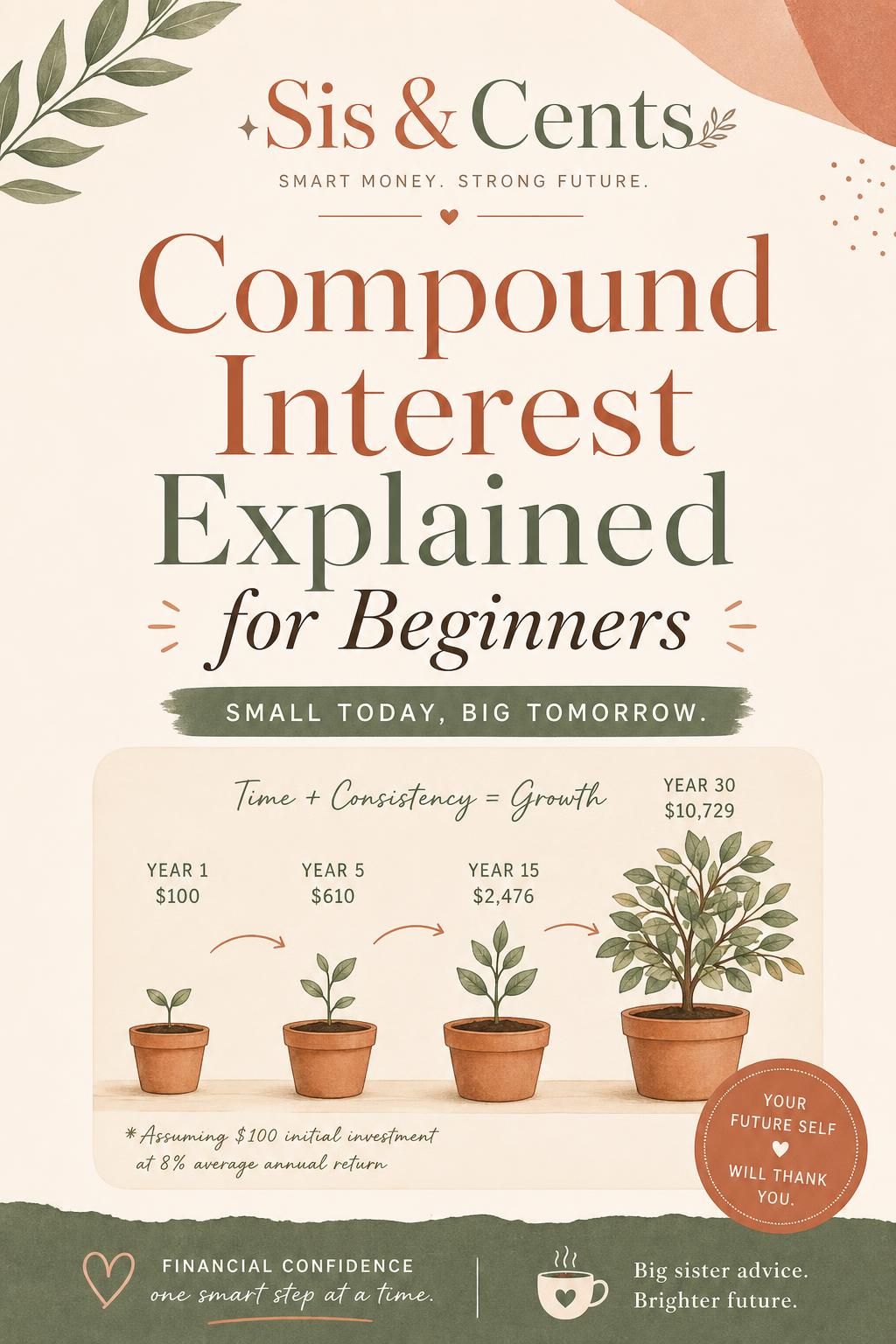
Compound interest is when the money you earn starts earning money too.
Here's the simple hypothetical version:
- You invest $100.
- You earn 8% interest this year = $8.
- Next year you earn 8% on $108 = $8.64.
- The year after that you earn 8% on $116.64 = $9.33.
That extra few cents doesn't sound like much at first. But over years and decades, those little extra earnings stack into something serious. The interest earns interest. The growth grows. That's the whole trick.
Compound interest vs simple interest
Simple interest is boring. It only pays you based on what you originally put in.
If you put $1,000 in an account with 5% simple interest, you get $50 every year. Forever. After 20 years you've earned $1,000.
With compound interest, that $50 gets added to your balance, and next year you earn 5% on $1,050. Then $1,102.50. Then $1,157.63. After 20 years, you've earned about $1,653 instead of $1,000.
Same starting amount. Same interest rate. Totally different ending point.
The rule of 72 (your new party trick)
Want to know how long it takes your money to double? Divide 72 by your expected annual return.
- 8% return → 72 ÷ 8 = 9 years to double
- 6% return → 72 ÷ 6 = 12 years to double
- 10% return → 72 ÷ 10 = 7.2 years to double
This isn't exact, but it's close enough to be useful. If you invest $5,000 at age 25 and it earns 8%, it could double to $10,000 by 34, $20,000 by 43, $40,000 by 52, and $80,000 by 61 — without you adding another dollar.
That's the power of time.
Why starting early matters more than starting big
This is the part that makes people wish they'd started yesterday. But here's the good news: if you're reading this, you still can.
Let's say two people invest $100/month until age 65:
- Bonnie starts at 25 and stops at 35. Invests for 10 years, then lets it sit.
- Lexi starts at 35 and invests for 30 years straight.
Assuming an 8% average annual return, Bonnie ends up with more money than Lexi — even though Bonnie only contributed $12,000 and Lexi contributed $36,000.
Time is the ingredient you can't buy later. Start small, start scared, just start as soon as you possibly can.
Where you actually get compound interest
Not every account compounds your money in a meaningful way. Here's where it actually happens:
- High-yield savings account — compounds daily or monthly, but rates are lower. Great for emergency funds, not wealth building.
- Roth IRA / 401(k) — your investments compound tax-free or tax-deferred. This is where the real magic lives.
- Index funds — low-cost funds that track the whole market and compound over time.
- Dividend reinvestment — when your dividends buy more shares, those new shares earn dividends too. Snowball effect.
A regular checking account or low-rate savings account is not going to compound your way to wealth. You need growth-focused accounts for that.
The biggest mistake people make
They wait. They think they need $1,000 or $5,000 or a "perfect" plan. Then five years go by and they haven't started.
You don't need a perfect plan. You need a consistent one. Even $25 a month, invested automatically, will compound into something real if you leave it alone.
The best time to start investing was 10 years ago. The second best time is today.
What to do this week
- Open a Roth IRA at Fidelity, Vanguard, or Schwab if you haven't already.
- Set up an automatic $25 or $50 monthly transfer.
- Invest it in a total stock market index fund or target date fund.
- Set dividends to reinvest automatically.
- Do not check it every day. Seriously. Leave it alone and let time work.
That's it. You don't have to pick stocks. You don't have to predict the market. You just have to start, stay consistent, and be patient.
Your future self is going to be so glad you did.
I'm rooting for you!
Keep reading, sis
 Investing
Investing 101: How to Start Investing With Zero Experience
Investing sounds like something rich people do. It's actually something *future*-rich people do. Here's how to open your first account and pick your first fund.
May 18, 2026 · 9 min read
 Investing
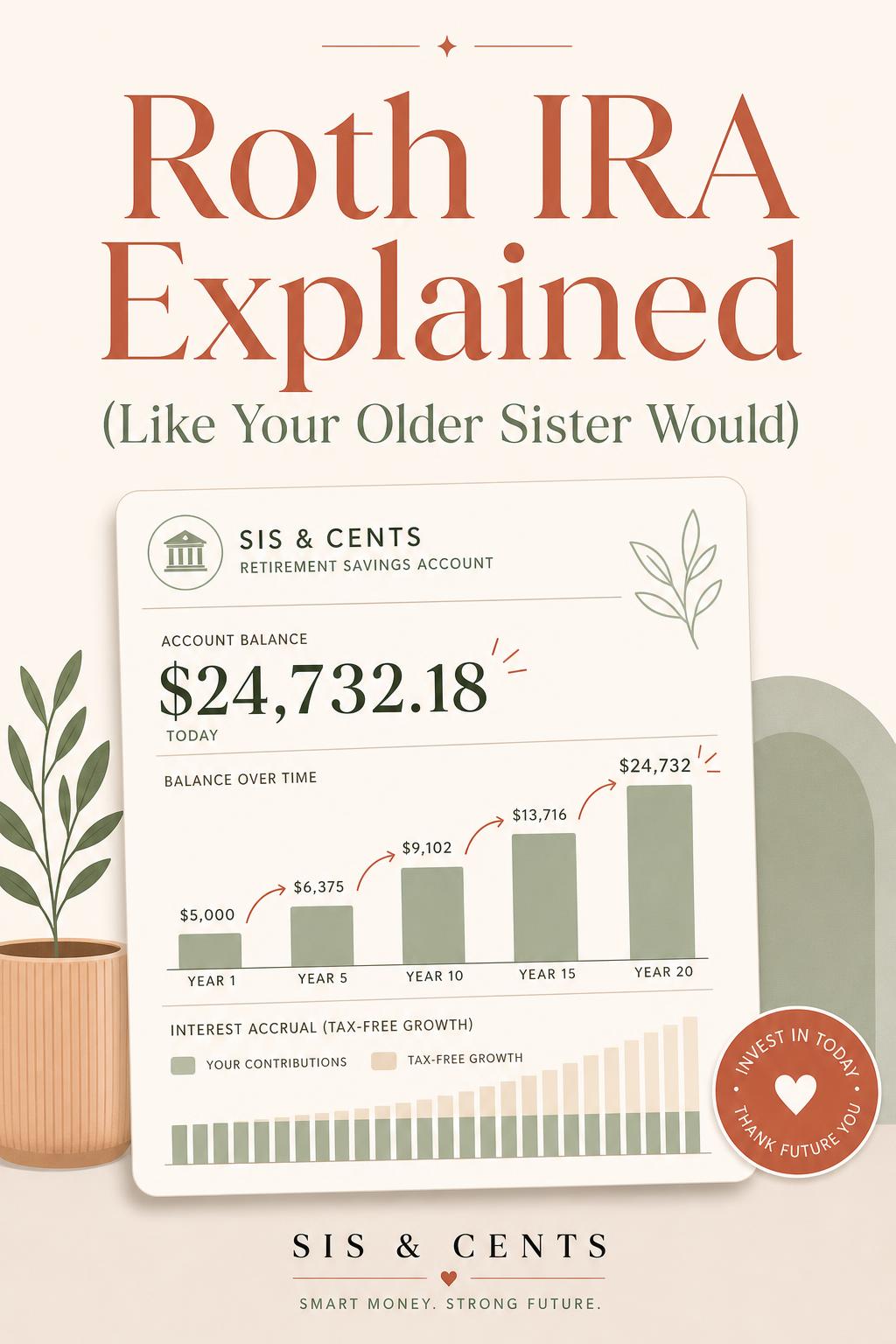
Roth IRA Explained (Like Your Older Sister Would)
It's not scary, it's not just for rich people, and it's honestly one of the best financial decisions you'll make this decade. Let's break it down.
March 28, 2026 · 7 min read
 Investing
The 5 Myths of Investing: Debunked
Think investing is only for rich people, stock pickers, or math aficionados? Let's bust the five biggest myths keeping you from building wealth.
August 13, 2026 · 8 min read
 Budgeting
The Beginner's Guide to Budgeting (Without Losing Your Mind)
Okay sis, sit down — we're going to build the first budget that actually works for you. No spreadsheets, no shame spirals. Just a real plan.
June 14, 2026 · 8 min read
Filed under